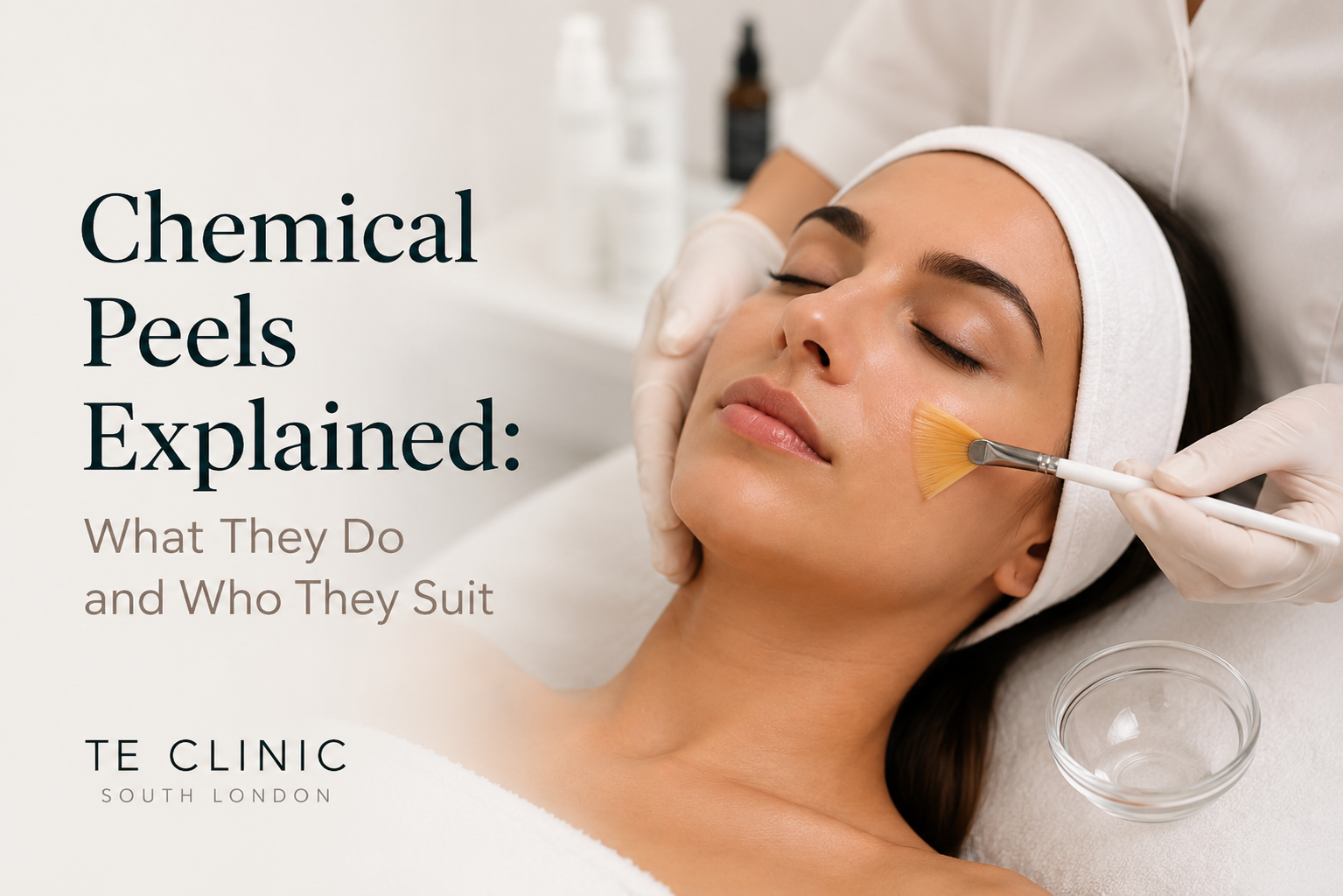
Chemical Peels Explained:
Chemical peels are one of the oldest treatments in aesthetic medicine, and also one of the most misunderstood. Many patients picture a peel as something dramatic, with days of raw, visibly peeling skin. In reality, most peels performed in clinic today are far more controlled than that, and the right peel is chosen to match your skin type and concern rather than applied as a one-size-fits-all treatment.
This guide explains how chemical peels actually work, the main types used in clinic, what conditions they can help with, and what a realistic recovery looks like. It is written by Aida, Specialist Clinical Pharmacist and Level 7 qualified aesthetic practitioner at TE Clinic South London, who performs all chemical peel treatments in clinic and brings a pharmacist's understanding of formulation and skin chemistry to every treatment plan.
How Do Chemical Peels Work?
A chemical peel involves applying an acid-based solution to the skin under controlled conditions. The acid works by breaking down the bonds between dead skin cells on the surface, encouraging them to shed and prompting the skin underneath to renew itself more quickly than it would on its own. Depending on the acid and strength used, this process can remain at a very superficial level or reach deeper into the skin, where it can also stimulate collagen production.
This is different to microneedling, which creates controlled micro-injury through fine needles to trigger the skin's repair response. A chemical peel works through chemical exfoliation at the skin's surface rather than mechanical injury, which is part of why the two are sometimes combined, but why they are not interchangeable.
The Main Types of Chemical Peel
Not all peels are the same, and the acid used matters as much as the strength.
AHAs (alpha hydroxy acids), such as glycolic acid and lactic acid, are water-soluble and work mainly on the skin's surface. Glycolic acid has a smaller molecule and penetrates faster, making it effective for brightening, evening out tone and softening fine lines. Lactic acid is gentler and more hydrating, which suits drier or more sensitive skin.
BHAs (beta hydroxy acids), most commonly salicylic acid, are oil-soluble, which allows them to get down into pores rather than sitting on the surface. This makes them particularly useful for oily and acne-prone skin, where they help clear congestion and calm inflammation.
TCA (trichloroacetic acid) peels work at a deeper level than AHAs or BHAs. Depending on the concentration used, a TCA peel can be formulated as a superficial, medium or deeper treatment, and is often used for more pronounced pigmentation, sun damage or textural concerns. Because TCA peels reach deeper into the skin, they involve more visible peeling and a longer recovery than a typical AHA or BHA treatment.
At TE Clinic South London, the peel type and strength are always matched to your specific skin, rather than defaulting to a single "house peel." A consultation with Aida will assess your skin type, current concerns and any sensitivities before deciding which acid, or combination of acids, is appropriate.
What Can a Chemical Peel Help With?
Chemical peels are used to treat a genuinely wide range of concerns, which is part of why they remain such a widely used treatment in dermatology and aesthetic medicine. Common concerns include:
• Dullness and uneven skin tone
• Mild to moderate pigmentation, including sun damage and post-acne marks
• Acne and congested, oily skin
• Fine lines and early textural ageing
• Enlarged pores and rough texture
A structured review of chemical peels for skin resurfacing, published via the National Library of Medicine's NCBI Bookshelf, confirms that peels are used across this same range of indications, including acne, pigmentation disorders, fine lines and photodamage, and notes their continued role in both cosmetic and medical dermatology. That range is exactly why a proper consultation matters. The acid, strength and depth suited to acne is often different to what is suited to pigmentation or fine lines, and choosing the wrong one is how patients end up disappointed with results, or with more irritation than expected.
Am I a Good Candidate for a Chemical Peel?
Chemical peels suit a broad range of skin types and concerns, but suitability still depends on your individual skin. You may be a good candidate if you have dull, congested or uneven-toned skin and want a non-invasive way to refresh it, if you experience breakouts or ongoing mild acne, if you have mild pigmentation from sun exposure or previous breakouts, or if you want to support and prolong results from other treatments such as microneedling.
Chemical peels are generally not suitable during pregnancy or breastfeeding, on actively inflamed or broken skin, or without a patch test and proper consultation if you have a history of cold sores, keloid scarring or very reactive skin. Darker skin tones can absolutely have chemical peels safely, but the acid, strength and aftercare need to be selected carefully to reduce the risk of post-inflammatory pigmentation, which is exactly the kind of judgement a pharmacist-led consultation is well placed to make.
What Does Treatment and Recovery Actually Involve?
A typical appointment starts with cleansing the skin to remove oil and debris, followed by careful application of the chosen acid solution. Most patients feel a mild tingling, warming or stinging sensation during application, which settles quickly. Depending on the peel, it may be timed and neutralised, or allowed to self-neutralise.
Recovery depends entirely on the depth of the peel. A superficial AHA or BHA peel typically causes only mild pinkness or light flaking for two to three days, similar to mild wind burn, with no real downtime. A deeper TCA peel involves more visible peeling, redness and sensitivity, often lasting five to seven days, and needs to be planned around your diary accordingly. Sun protection is essential after any peel, since freshly exfoliated skin is more vulnerable to UV damage and pigmentation.
Results build gradually as the treated layer of skin renews itself, and most patients need a course of treatments, spaced several weeks apart, rather than a single session, for the best outcome on concerns like pigmentation or acne scarring.
How Does This Compare to Other Treatments at TE Clinic?
Patients often ask how a chemical peel compares to microneedling, since both are used to improve skin texture and tone. Microneedling works through controlled physical micro-injury to trigger collagen production from within the skin, and tends to be the better choice for textural concerns like enlarged pores, mild scarring and overall skin quality. A chemical peel works through chemical exfoliation at the surface, and tends to be the better choice for pigmentation, dullness and acne-related congestion. The two are frequently used as complementary treatments within a broader skin plan, rather than as competing options, and this is something Aida will talk through at your consultation.
Booking a Chemical Peel in Crystal Palace
TE Clinic South London is based in Crystal Palace and welcomes patients from across South London, including Dulwich, Bromley, Croydon, Norwood, Chislehurst and Beckenham. Every chemical peel is performed by Aida, our Specialist Clinical Pharmacist, and every treatment plan begins with a consultation to make sure the peel type and strength genuinely match your skin.
If you're dealing with dullness, pigmentation, acne or uneven texture and want to understand which type of peel would suit you, book a consultation to talk it through.